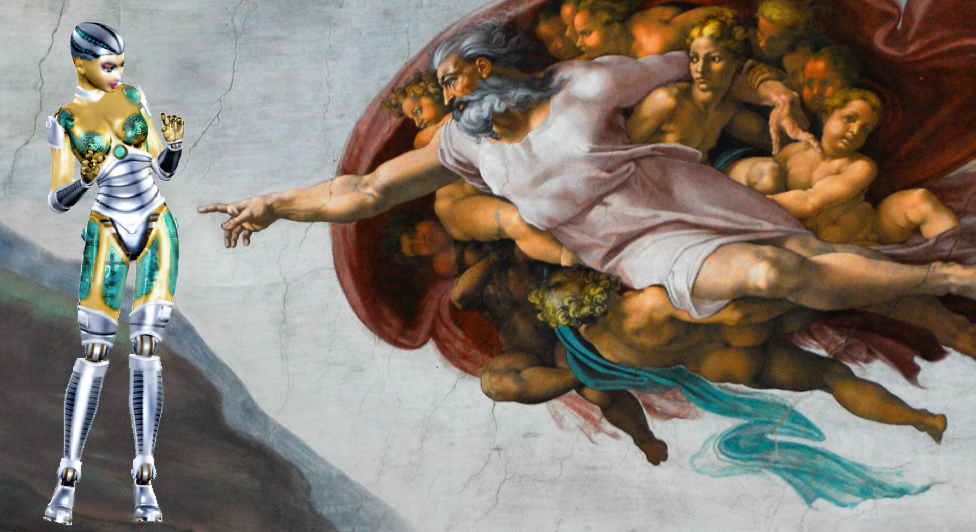
Humans began their technological hybridization at the dawn of the paleolithic era with cultural innovations such as simple tools and the harnessing of both fire and language -much in the same way that we see chimpanzees and other primates doing now. Fast forward to humans as Earth’s dominant super-species: breaking out of the gravitational lock on our global civilization, peering into the furthest reaches of the cosmos to see the echos of the Big Bang, mapping out the quantum landscape at the foundations of matter/energy, linking every part of the globe with land and space-based IT webs, galloping into the realms of virtual reality and hyper-computing with blisteringly fast computational data centers that clock in at hundreds of teraflops a second and… (the holy grail of transhuman evolution) sashaying through the AI Turing Test turnstiles with scarcely an over-the-shoulder glance.
“Robots with biological brains and biological bodies with digital devices already exist, as do human-computer and brain-machine interfaces.”
I remember well my paternal Grandmother (born a stretch before radio and airplanes) struggling to cope with such advanced forms of tech as a TV remote. Not wishing to become a technological outcast, I am doing my best to buttress my mind against the tsunami that is presently crashing over our collective heads in the form of tech and AI advancements. A peek into the Canadian government’s uber-creepy attempt to normalize the globalist agenda of turning us all into cyborgs gives a drip-feed of clues as to what we might be coping with in the improbable future that is unfolding before us in this very moment [https://horizons.gc.ca/en/2020/02/11/exploring-biodigital-convergence/]
If you happen to be curious go to the section titled:
Full physical integration of biological and digital entities
“Digital technology can be embedded in organisms, and biological components can exist as parts of digital technologies. The physical meshing, manipulating, and merging of the biological and digital are creating new hybrid forms of life and technology, each functioning in the tangible world, often with heightened capabilities.
Robots with biological brains and biological bodies with digital brains already exist, as do human-computer and brain-machine interfaces. The medical use of digital devices in humans, as well as digitally manipulated insects such as drone dragonflies and surveillance locusts, are examples of digital technology being combined with biological entities. By tapping into the nervous system and manipulating neurons, tech can be added to an organism to alter its function and purpose. New human bodies and new senses of identity could arise as the convergence continues.”
Chances are that you have completely adapted to living life enmeshed with the passive AI nodes we benignly call cell phones. One or two more generations of Siri and Alexa (fours years…. tops) and you will be having a primary relationship with the training-wheels version of AI the tech overlords begrudgingly allow you access to (I will put good money on that many people now are in primary relationships with virtual AI agents and don’t even know it). How long after that until we loose the clunky and cumbersome bricks we call phones in exchange for an easily implantable up-grade (that comes with a discount early-subscription offer… and a ten thousand page ‘terms and conditions’ contract [click here to agree])? The domains already forged within virtual on-line games span entire galaxies. Neural-link enhanced brains will operate at computational speeds a million times faster than the old-fashioned homegrown version, and kids (living in timeframes that dwarf biology) may well live simulated lifespans in the thousands of years. What on Earth will you have in common with these beings?
Kubrik/Clarke’s Dave Bowman ends up living out his biological sentence as a zoo specimine, only to be re-born as a ‘Starchild’. In Spielberg’s AI, David suffers a similar fate when he manages to survive beyond the next ice-age to be resurrected by the successive race of anthropological mechano-bioids. These scenarios, though seemingly taken to the extreme, may not be so implausible given what we can do even today. So, what’s your call: specimen or spectator? How will you handle the re-defining of ‘humanity‘? If we as a species are having such a hard time dealing with such prosaic issues as the differences in race and culture, what will it be like to grapple with a meta that has introduced transhuman X-Men and extraterrestrials onto the gameboard?
 transform-bodywork.health.blog