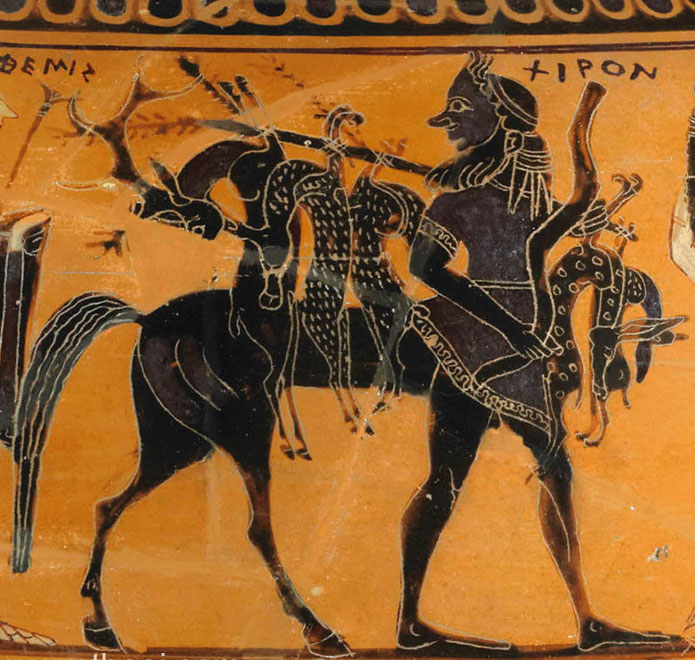
In the ancient mythological world of Greece there existed a Thessalian tribe of chimeric kentauroi, or centaurs -creatures who were half human and half horse. They were generally a savage and untamable lot, but one among them, Chiron, son of the Titan Cronus, was exalted and recognized as having special status as possessing insight, knowledge and wisdom. The wisest and most just of all centaurs, he was also known to be a skilled healer of remarkable ability and was sought as a physician and teacher of the medical arts by the likes of Heracles, Achilles and Asclepius. Chiron is specifically known for a severe injury he received whilst in battle with Heracles where he was accidentally shot with a poisoned arrow. For mere mortals the poison, coming as it did from the Hydra, meant certain and immediate death. However, being the spawn of a Titan meant he was an immortal. So Chiron was condemned to live on, though having to endure the incessant agony of his unhealable injury. He is still recognized to this day in Western astrological systems and he symbolizes the archetype of the ‘wounded healer’.
I doubt that there is a single gifted healer who is truly called to the healing path who cannot identify with this motif. Indeed, as healers we are called upon with a unique urgency to find our own journey of self-inquiry through seeking and addressing the deepest wounds we have received, both in this life as well as previous ones. Not only do we discover a most profound type of intimacy with ourselves but we also come into contact with the very root of what it means to be wounded, to be abused or broken by this path of being human; and by doing so we also touch upon the meaning and fragility of mortality. As with Chiron, it also brings us to the heart of an existential dilemma…
Ultimately, one who attains spiritual liberation heals the deepest wounds of all.
Accessing and working with our own wounds gives us a self-knowledge that is primarily experiential and it provides a number of significant effects. One is that we have the opportunity to come to know the nature of illness or disease at the vibrational/intuitive level which gives us a kind of sensing that aids and supports assessing medical conditions that may otherwise only be done through rational or suppositional thought processes. Without the ability to ‘feel’ the disease, knowledge becomes theoretical and abstract. It may well be effective but it is nonetheless superficial. Another effect is that as we come to appreciate the vulnerability of being alive, we thereby have the opportunity to develop profound compassion for others who are being challenged on their own healing path. Without the ability to identify as self with a client (either quite literally or at the very least, by extension) we run the risk of mere objectification. Therefore, the effect we may have on those we seek to help will again be at the surface, as if simply treating and abating symptoms is sufficient.
Furthermore, there is a kind of angst that is innate to existence and most people go through their entire lives avoiding it or, worse, never becoming aware if it in the first place, such is the degree of ignorance and distraction within which we find ourselves -these so-called modern times. Our ability to know ourselves is based in that organ of reflexive self-awareness and expression, which here we will provisionally call an ego. The ability to know the difference between I and you is central to the function of the ego. Furthermore, the ego is also the way by which we express agency and thereby map and plan out our course through life. But the marriage of this awareness and the ability to make abstractions about the future comes at a terrible cost -that, ultimately, is the knowledge of mortality and death. Having no mere insignificant vested interest in self-preservation the ego positions itself in such a way as to model and predict life so as to optimize survival while at the same time adroitly side-stepping having to come to terms with the the ultimate wound; the inevitability of death. For the ego the possibilities boil down to ending tenure in annihilation, insanity, or death. Since none of these are acceptable options the ego will forever avoid them (often nonchalantly, the master magician and past master of misdirection)… sometimes aggressively (through addictions or other forms of obsessive-compulsive behaviors). All the while our avoidance mechanisms sweep a compounding anxiety of that inevitable fate underneath the proverbial rug.
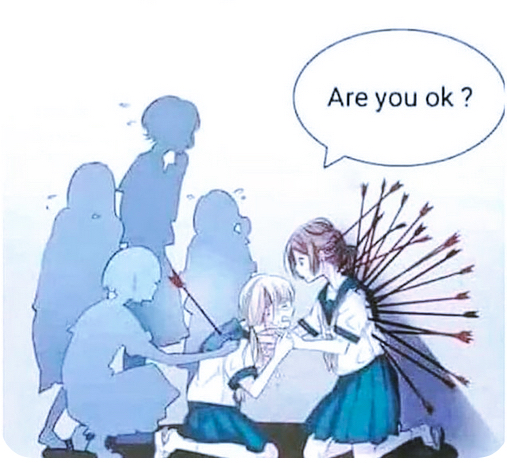
Central to the Mahayanist Buddha Dharma is the notion of the Bodhisattva -a being who forsakes his or her own ultimate emancipation in order to be of compassionate service to others, ultimately to the point of forestalling complete enlightenment until all other beings are themselves enlightened. From the Buddhist perspective, the very nature of being embodied in a material dimension entails ‘struggle’ and is therefore a realm where suffering is intrinsic to existing. Chiron’s unhealable injury can be seen metaphorically as the suffering endemic to human life. In Chiron’s case, this struggle is made even worse for he is the master healer who is possessed of an intractable malady. The agony of his wound is inseparable with his existence, compounded by the fact that, despite his mastery as a physician, as an immortal his fate was apparently cast to suffer without end. For us normal people this predicament appears outrageous indeed, yet as mortals we all face our individual (sometime collective) poisoned arrows. Life crushing illness is a reality for many. There are numerous pathologies such as trigeminal neuralgia (known as the ’suicide disease’), TMJ, burn victims, and untreatable cancers which cause unimaginable pain, and from which death is a welcome release.
One of lessons embedded in Chiron’s archetype is that there is no excuse for not taking our art to the highest levels. At the same time we should not overlook that Chiron finally resolved his predicament and chose to forsake his immortality. Zeus honored him and placed him amongst the stars as the constellation Centarus, or Sagittarius as we call it today. Seeing that kind of beauty interwoven with tragedy is germane to the Greek way of seeing life. We all have potential to master and share great gifts, yet there are are limits to what we can not only do but, ultimately, endure. How that plays out is up to us, each to their relative capacity to perceive, understand, serve, endure and ultimately transcend. These processes of self-exploration can be honed to a fine edge through the Buddhist heuristic. Through the Dharma, the existential dilemma resolves in the now, and this brings us to the notion of addressing the deepest wounds of all: being confronted with insanity, annihilation, or the purity of the destruction of death. Not every client interaction is life and death, but spend enough time in service and you will inevitably come face to face with the most challenging issues of being alive. The depth and degree of how you address your own challenges will determine your capacity to be of genuine service to others. Ultimately, one who attains spiritual liberation heals the deepest wounds of all. Chiron transcended his dilemma through death. But if, like the Buddha, such a being were able to do so and still walk the Earth, that healing would be spread out like ripples over a vast ocean of space and time, ultimately touching and easing the suffering of uncountable others. May it be so.
 transform-bodywork.health.blog